
With NHS waiting lists for neurodevelopmental reviews now stretching up to seven years in some regions, the search for a private adult adhd assessment uk has become a necessity rather than a luxury for those seeking clarity. You've likely spent years wondering why "simple" tasks feel like climbing mountains, only to be met with a GP's dismissive shrug or a soul-crushing wait time. It's exhausting to feel like your internal engine is constantly revving in the wrong gear. You are not broken. You deserve a space where your differences are recognised as fundamental traits rather than problems to be solved.
This guide provides the clinical roadmap you need to move beyond the overwhelm of choosing a provider and into a life of functional strategies and legal validation. We'll explore how to identify a truly neuro-affirming specialist and what the 2026 diagnostic standards require. You'll also learn how a formal diagnosis unlocks the workplace adjustments you deserve under the Equality Act 2010. We're here to help you transition from a place of lifelong struggle to a structured, supportive strategy for your future.
Key Takeaways
- Understand how a private adult adhd assessment uk bypasses years of waiting lists by providing a direct, remote pathway to clinical clarity.
- Learn to identify high-quality care by looking for providers who follow NICE guidelines and prioritise a thorough exploration of your developmental history.
- Evaluate the importance of clinician continuity, ensuring the same specialist supports you through assessment, prescribing, and coaching.
- Discover practical steps to prepare for your interview, from collating old school reports to maintaining a real-time symptom diary.
- Explore the transition from diagnosis to a life-changing support strategy involving careful medication titration and neuro-affirming coaching.
The Journey to Clarity: Understanding Private Adult ADHD Assessments in 2026
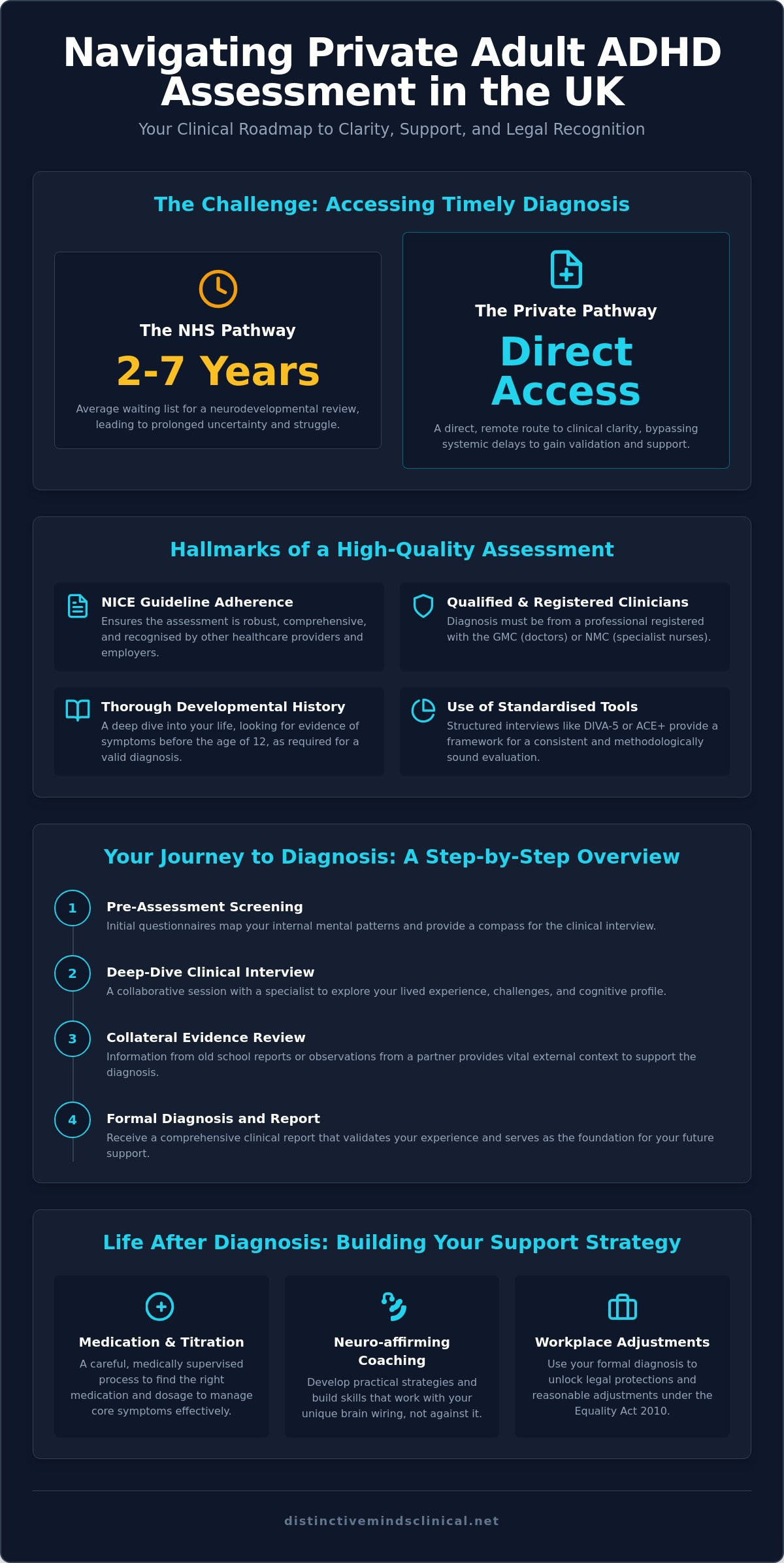
A private adult adhd assessment uk is a comprehensive clinical investigation designed to provide clarity when the public healthcare system cannot. In 2026, the landscape of neurodiverse care has shifted significantly. NHS waiting times now average between two and seven years, leaving millions of adults in a state of professional and personal limbo. A private assessment offers a faster, more specialised alternative. It's not merely a medical transaction; it's a collaborative process between you and a clinician who understands the internal patterns of a neurodivergent mind. We focus on a neuro-affirming framework. This approach validates your lived experience and identifies your unique cognitive profile rather than focusing solely on perceived deficits.
A foundational part of this journey is Understanding ADHD as a lifelong neurological difference. When you step outside the NHS pathway, you gain access to specialists who have the time to conduct a truly deep dive into your history. This is vital for clinical validity. Your assessment must be robust enough to stand up to scrutiny from other healthcare providers and employers. It's about building a bridge between your past struggles and your future potential.
Why Adults Seek Private Assessments
Many adults reach out when the "masking" strategies they've used for decades finally fail. The impact of undiagnosed ADHD on career progression and mental health is significant. You might feel a persistent sense of underachievement or chronic burnout. Seeking a private assessment provides timely intervention that can prevent further decline. By choosing a specialist who focuses exclusively on adults, you ensure your assessment isn't viewed through the lens of childhood behaviour alone. It addresses the complexities of adult life, from managing a household to navigating corporate environments.
The Legal and Clinical Validity of Private Diagnoses
For a diagnosis to hold weight, it must be conducted by a qualified professional registered with the GMC or the NMC. A diagnosis provided by a Registered Mental Health Nurse (RMN) with extensive specialist experience is both robust and legally recognised. This clinical authority is essential when seeking workplace adjustments or a Shared Care Agreement with your GP. Whilst the "Right to Choose" pathway exists for NHS patients in England, the fully private route remains the fastest way to access care. It provides a direct line to clinicians who can manage your entire journey, from the initial interview to medication prescribing and ongoing coaching.
The Clinical Framework: NICE Guidelines and Diagnostic Excellence
Excellence in diagnosis isn't about speed; it's about clinical depth. To ensure your private adult adhd assessment uk is recognised by the NHS and employers, it must align strictly with the NICE Guidelines. These standards demand more than a simple questionnaire. They require a specialist to explore your current functional impairments alongside a detailed retrospective of your childhood. ADHD is a neurodevelopmental condition. This means symptoms must have been present before the age of 12, even if they were successfully masked at the time. A robust clinical evaluation uses standardised tools like the DIVA-5 or ACE+ interviews to provide a structured yet flexible framework for this exploration.
A diagnosis is a clinical judgement, not a tick-box exercise. It requires a professional who can interpret the nuances of your internal experience. We look for the "why" behind the behaviour, not just the behaviour itself. This methodical approach ensures that the results are clinically robust and provide a definitive anchor for your future support strategy.
The Components of a Comprehensive Assessment
A thorough assessment begins long before the remote interview. It starts with pre-assessment screening questionnaires that help map your internal mental patterns. These tools aren't diagnostic on their own; they serve as a compass for the clinical interview. During the deep-dive session, your specialist will look for evidence of executive dysfunction across multiple areas of your life. This often involves reviewing collateral evidence. Old school reports or observer forms from a partner can provide vital external context. They help bridge the gap between how you feel internally and how your brain interacts with the world.
Beyond the DSM-5: A Holistic Perspective
Clinical judgement is the most critical element of the process. A specialist must look beyond the surface-level criteria of the DSM-5 to identify "masking," which is the exhausting process of mimicking neurotypical behaviour to fit in. This is particularly common in women and high-achieving professionals. A true expert ally also conducts a differential diagnosis to rule out or identify co-occurring conditions like sensory processing issues or anxiety. Neuro-affirming care is a practice that respects the individual’s unique neurology. It's about partnership. If you're ready for a process that values your personal narrative, you can enquire about our clinical approach to find out how we can support your journey.
Choosing Your Provider: Specialist Solo Practices vs. Clinical Organisations
Selecting where to undergo your private adult adhd assessment uk is a decision that shapes your entire diagnostic experience. Many large clinical organisations operate on a "factory" model. In these settings, you might be passed between different clinicians for screening, the diagnostic interview, and eventual titration. This fragmented approach often lacks the depth required to understand a complex adult life. In contrast, a specialist solo practice prioritises clinician continuity. Seeing the same expert for your assessment, medication prescribing, and coaching ensures that your unique history isn't lost in a file. It creates a steady, reliable rhythm that reduces the anxiety often associated with medical environments.
A remote-first service offers specific advantages for neurodivergent adults. Traditional clinics can be sensory minefields. Bright lights, ticking clocks, and the stress of travel can all trigger a "masking" response that obscures your true symptoms. By conducting the assessment from your own home, you remain in a controlled, comfortable environment. This allows for a more authentic clinical picture to emerge. Whilst the NHS assessment process is the standard benchmark, the private sector allows for this level of environmental tailoring that public services simply cannot match.
The "Expert Ally" Model
The "expert ally" model is a significant departure from traditional, detached medicine. It features practitioners who combine high-level clinical rigour with their own lived experience of neurodiversity. This shared perspective bridges the gap of understanding. It transforms the assessment from a cold interrogation into a non-judgmental sanctuary. When your clinician understands the internal weight of executive dysfunction, the power imbalance shifts. You aren't just a patient being observed; you're a partner in a process of discovery. This validation is often the first step toward healing years of self-doubt.
Red Flags to Avoid in Private ADHD Care
The rise in demand has unfortunately led to the emergence of "diagnosis mills." These providers often offer cut-price, 30-minute assessments that lack a proper developmental history. Be cautious of any service that doesn't ask for school reports or observer forms. Transparency is also vital. Ensure your provider offers clear pricing for follow-up care and titration before you commit. Most importantly, verify that your clinician is registered with the appropriate UK professional bodies. A Registered Mental Health Nurse (RMN) should be on the NMC register, and a psychiatrist must be on the GMC register. Without these credentials, your diagnosis may not be recognised for workplace adjustments or Shared Care Agreements.
Practical Preparation: Navigating Your Diagnostic Interview with Confidence
Preparing for a private adult adhd assessment uk can feel like a daunting administrative task. However, viewing it as a project of self-discovery can shift your perspective from anxiety to empowerment. The goal is to provide your clinician with a high-resolution map of your internal world. This starts with a methodical approach to your history and current functional struggles. By arriving prepared, you ensure that no detail is lost to the "brain fog" or memory gaps that often accompany clinical discussions. You aren't just a passive subject; you're the primary witness to your own neurology.
- Step 1: Collate historical evidence. Look for old school reports that mention being "easily distracted" or "not reaching full potential." If these aren't available, your own memories and feedback from those who knew you as a child are valid clinical data.
- Step 2: Keep a symptom diary. For one week, record moments where your executive function falters. Note when you struggle to start a task, lose your focus, or feel overwhelmed by sensory input. Real-time data is far more accurate than retrospective memory.
- Step 3: Focus on functional impact. Consider how ADHD affects your work, health, and relationships. It isn't just about being "messy"; it's about the chronic stress and exhaustion of trying to keep up with neurotypical expectations.
- Step 4: Prepare your questions. Think about what you want from your future. Ask about medication, neuro-affirming coaching, and how to manage the transition to a post-diagnostic life.
Gathering Your Developmental History
If you have missing school reports or estranged family members, a diagnosis is still entirely possible. Specialists are trained to look for "hidden" childhood symptoms that teachers might have missed. You might have been the quiet daydreamer or the "too sensitive" child who never caused trouble but struggled internally. Use old photos or journals to trigger these memories. They often hold the keys to understanding your lifelong internal patterns and the origins of your masking behaviours.
Articulating the Internal Experience
When describing your struggles, move beyond surface-level traits. Instead of saying "I am messy," explain that your brain lacks the executive function to sequence the steps required to tidy. Discuss the immense emotional cost of masking at work and the burnout it causes. If you experience Rejection Sensitive Dysphoria (RSD), be open about how a perceived slight can spiral into days of social withdrawal. This level of detail helps your clinician provide the clinical clarity you seek. If you are ready to begin this process, you can book your adult ADHD assessment to start your journey with a specialist who understands your perspective.
The Post-Diagnostic Pathway: Medication, Titration, and Neuro-Affirming Coaching
Receiving a diagnosis is often a moment of profound emotional release. It's the validation of a lifetime of internal friction and the end of a long search for answers. However, your private adult adhd assessment uk is the beginning of a new chapter, not the finish line. Clinical clarity is the foundation upon which you build a sustainable support strategy. Once the "why" of your struggles is established, the focus shifts to the "how" of your future. We move from identifying patterns to managing them with precision and empathy.
Medication titration is the methodical process of finding the specific dose and molecule that harmonises with your unique brain chemistry. It's a delicate balance. This isn't a one-size-fits-all medical transaction; it requires careful tracking of your internal states and functional improvements. To support this, we introduce non-medical titration coaching. This unique approach allows you to track cognitive patterns and manage the emotional transitions that occur as your brain begins to process information differently. Medication effectively lowers the internal noise. It doesn't, however, build the practical skills needed to navigate a neurotypical world.
Navigating Medication and Prescribing
Private prescribing provides a direct route to treatment whilst public services remain overwhelmed. Your medication is managed safely by a Registered Mental Health Nurse (RMN) who understands the nuances of adult neurodiversity. Once you reach a stable dose, we work toward a Shared Care Agreement with your GP. This transition allows your local surgery to take over the prescribing at NHS rates, provided they agree to the specialist oversight. It's a collaborative bridge between private expertise and public healthcare. We ensure you're supported until that stability is reached, prioritising your safety and clinical outcome above all else.
The Power of ADHD Coaching
Coaching is the process of building "scaffolding" around your executive function deficits. It's a strategic partnership designed to help you work with your neurology rather than against it. For high-achievers, this often means unlearning the "hustle culture" habits that lead to burnout and replacing them with strengths-based strategies. You can explore ADHD Coaching for Neurodivergent Growth to understand how we bridge the gap between a clinical diagnosis and daily functional success. We help you honour your brain's natural rhythm whilst maintaining your professional and personal ambitions.
Why Distinctive Minds Clinical is Your Partner for Change
We provide a sanctuary for adults who seek more than just a label. Our remote, adult-only practice is built on the belief that lived experience and clinical rigour are equally vital. You aren't just another file in a clinical factory; you're a person seeking a tailored, human-centric experience. We invite you to step into a space where your differences are understood and your potential is recognised. You can book your private adult ADHD assessment today to begin your journey toward lasting self-understanding and support.
Taking the First Step Toward Clinical Clarity
Deciding to pursue a private adult adhd assessment uk is a significant act of self-advocacy. You've spent long enough navigating a world that wasn't built for your brain. By focusing on clinical excellence and preparing your functional history, you've already laid the groundwork for a successful diagnostic outcome. A formal diagnosis is more than a label; it's the key to accessing medication, coaching, and the legal protections you deserve under the Equality Act 2010.
Our practice is led by B. Rose Sparrow, a Registered Mental Health Nurse with 18 years of clinical experience and firsthand lived-experience insight. We provide a completely remote, adult-only environment that respects your sensory needs and professional schedule. This is a space where your neurology is understood, not pathologised. We focus on partnership and systematic tracking to ensure your post-diagnostic pathway is steady and reassuring.
Start your journey to clarity with a specialist adult ADHD assessment. Your future of self-understanding and functional success starts here. Reach out today to move toward the life you've always known was possible.
Frequently Asked Questions
Is a private ADHD assessment valid in the UK?
A private assessment is entirely valid provided it is conducted by a qualified healthcare professional with specialist expertise in ADHD, such as a psychiatrist or a Registered Mental Health Nurse (RMN). To be robust, the evaluation must follow the NICE [NG87] guidelines, which require a full clinical and psychosocial assessment. This clinical validity is essential for securing workplace adjustments under the Equality Act 2010 or requesting a Shared Care Agreement with your GP.
How much does a private adult ADHD assessment cost in 2026?
Costs for a private adult adhd assessment uk vary significantly depending on the provider and the depth of the service. Some clinics charge a flat fee for the initial diagnostic interview, whilst others offer packages that include follow-up consultations and titration. It's vital to check whether the price includes the final clinical report and any necessary liaison with your GP, as these are often charged as additional administrative fees.
Will my GP accept a diagnosis from a private specialist nurse?
GPs can accept a diagnosis from a specialist nurse, provided the practitioner is registered with the Nursing and Midwifery Council (NMC) and has the appropriate clinical specialism. However, whether a GP agrees to a Shared Care Agreement for medication depends on local Integrated Care Board (ICB) policies and individual GP discretion. It's often helpful to discuss your choice of provider with your GP before the assessment to understand their specific requirements for clinical reports.
Can I get ADHD medication immediately after my assessment?
Medication cannot be dispensed immediately after a diagnostic interview. The assessment is the first step to confirm your neurodivergent profile. If medication is recommended, you must enter a titration phase. This is a careful, monitored process where a specialist adjusts your dosage over several months to find the most effective balance for your brain chemistry with minimal side effects.
What is the difference between a psychiatrist and a specialist ADHD nurse?
Both psychiatrists and specialist nurses, such as Registered Mental Health Nurses (RMNs), are qualified to diagnose ADHD if they have the required specialist training. Psychiatrists are medically trained doctors, whereas specialist nurses are senior healthcare professionals with extensive psychological and neurological expertise. In many modern clinics, specialist nurses lead assessments because their background often provides a more holistic, neuro-affirming perspective on your lived experience.
Do I need a referral from my GP for a private assessment?
You don't need a GP referral to access a private assessment. You can self-refer directly to a specialist practice. This direct pathway is one of the primary reasons many adults choose the private route, as it bypasses the current NHS waiting lists which, as of April 2026, can range from two to seven years depending on your location in the UK.
What happens if I was diagnosed as a child but need a reassessment as an adult?
Adults diagnosed in childhood often require a transition review or a fresh assessment to access treatment as an adult. This is because childhood diagnostic criteria focus on school-based behaviours, whereas an adult assessment explores executive dysfunction in the context of work, relationships, and independent living. A current review ensures your support strategy is tailored to your adult life and meets modern clinical standards for prescribing.
How long does the private ADHD diagnostic process take from start to finish?
The initial private adult adhd assessment uk can typically be booked within two to six weeks. After the diagnostic interview, you'll usually receive your clinical report within a further week or two. If you choose to pursue medication, the titration process can take an additional three to six months to reach a stable dose before you can be considered for a Shared Care Agreement with your GP.