

What if the most critical factor in finding your "therapeutic window" isn't just the chemistry of the medication, but the quality of the data you collect along the way? For many, the process of adjusting a new prescription feels like a high-stakes guessing game. You might worry about forgetting to record your daily observations or feel anxious that you aren't capturing the "right" side effects to show your prescriber. We understand that asking an ADHD brain to maintain a meticulous daily record is a significant challenge. This guide provides the adhd titration log help you need to bridge the gap between your internal lived experience and the clinical data required for a successful outcome.
We agree that traditional tracking methods often feel detached and overwhelming. You need a system that respects your neurobiology rather than one that demands you fight against it. Our promise is to equip you with a clear, simple framework for tracking your medication journey with absolute confidence. We will walk through practical templates and clinical insights designed to help you identify your optimal dose faster. By the end of this guide, you'll have a well-mapped path forward, turning a clinical chore into a powerful tool for self-understanding.
Key Takeaways
- Understand how a titration log acts as a vital communication bridge between you and your clinician to ensure a safer, more efficient medication journey.
- Learn to identify the "Big Three" metrics-core symptoms, side effects, and internal patterns-to get the most effective adhd titration log help during your reviews.
- Shift your focus from daily fluctuations to 7-day trends to accurately visualise your "therapeutic window" and find your optimal dose.
- Implement "minimum viable" tracking strategies that bypass executive dysfunction by using simple digital tools, alarms, and voice notes.
- Discover how non-medical titration coaching can translate your raw data into meaningful insights that empower your clinical decision-making.
What is an ADHD Titration Log and Why is it Essential?
Titration is the systematic, clinical process of finding your optimal dose. It's a journey of discovery. We aren't just looking for "more focus"; we're hunting for the precise point where your symptoms improve with the absolute minimum of side effects. This period is arguably the most critical phase of your treatment. Without a structured way to record your experiences, the process can feel like navigating a heavy fog without a compass. This is where seeking adhd titration log help becomes essential. It transforms vague, fleeting feelings into actionable data that your clinician can actually use.
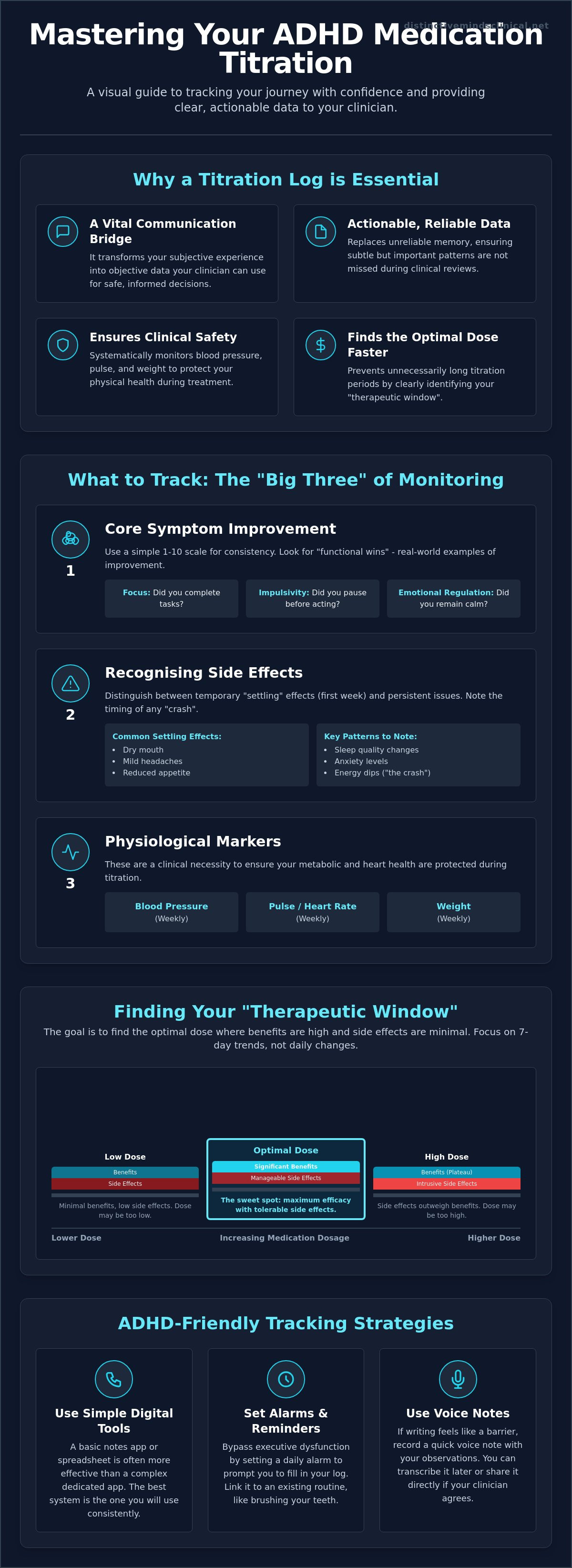
In the UK, your prescriber relies entirely on your feedback to make safe, informed decisions. Your log acts as a vital communication bridge. It ensures that when you sit down for your review, you aren't relying on a memory that might be naturally affected by the very ADHD you're trying to treat. "Winging it" often leads to unnecessarily long titration periods. You might miss your therapeutic window entirely because a subtle but important pattern wasn't recorded at the time. Beyond symptom tracking, monitoring your blood pressure, pulse, and weight is a clinical necessity. These physiological markers ensure your heart and metabolic health remain protected whilst you find the right balance of common ADHD medications.
The Purpose of Your Observations
Your observations serve a dual purpose: safety and efficacy. We need to identify your "therapeutic window," which is the specific dosage where the cognitive benefits clearly outweigh any physiological strain. By providing objective data, you give your clinician the evidence they need to justify dose adjustments or, if necessary, a switch to a different medication class. It's about moving from "I think I feel better" to "I can see a clear improvement in my task initiation over the last seven days." This clarity reduces the anxiety of "doing it wrong" and keeps the process moving forward.
Common Titration Log Formats in the UK
The format of your log often depends on your specific provider. Many NHS services still utilise traditional paper forms, whilst private clinics frequently offer secure digital portals for real-time updates. You might feel overwhelmed by the choice of dedicated ADHD tracking apps. These can be brilliant for setting automated reminders, but they can sometimes feel too complex for a brain already struggling with executive function. Often, a simple, personalised system, such as a dedicated notebook or a basic spreadsheet, is the most effective way to ensure consistency. The best system is always the one you actually feel capable of using every single day without it becoming a source of stress.
What to Track: The "Big Three" of ADHD Medication Monitoring
Tracking your journey shouldn't feel like a full-time job. To avoid the burnout that often comes with daily data entry, we categorise your observations into three distinct pillars. This structured approach provides the adhd titration log help you need to communicate clearly with your clinician without feeling like you're writing a novel every evening. By focusing on symptoms, side effects, and physiological markers, you create a high-resolution map of how your neurobiology is responding to the treatment.
Your prescriber needs to know how the medication affects your "internal weather" and your physical health. Following official treatment guidelines ensures that dosage adjustments are based on a safe balance of benefits and tolerability. We also pay close attention to "the crash." Recording exactly when your medication wears off helps your clinician decide if a second dose or a different release profile is necessary to support your entire day.
Measuring Symptom Improvement
Consistency is more important than detail. Use a simple 1-10 scale to rate your focus, impulsivity, and emotional regulation each day. Look for "functional wins" rather than just a feeling of being "on." Did you finish a report without four coffee breaks? Did you stay calm whilst stuck in traffic? These real-world examples provide concrete evidence of efficacy. We also track the duration of the "quiet brain" effect. Knowing if your medication lasts six hours or ten hours is vital for fine-tuning your schedule.
Recognising and Recording Side Effects
It is normal to experience "settling" effects during the first week. These often include a dry mouth, mild headaches, or a slight decrease in appetite. We distinguish these from "intolerable" effects that significantly impact your quality of life. If you feel "zombie-like" or notice a sharp increase in anxiety, these internalised states must be recorded clearly. Red flag symptoms, such as chest pain or severe palpitations, require immediate clinical contact. If you find yourself struggling to translate these internal feelings into words, our non-medical titration coaching can help you articulate these experiences for your next review.
Finally, we never ignore the non-negotiables. You must record your blood pressure, heart rate, and weight as requested by your UK provider. These figures are the safety rails of your titration. When paired with your sleep patterns and appetite notes, they provide a complete picture of your physical well-being. This data ensures that your path to the "sweet spot" is not only effective but fundamentally safe for your long-term health.
Interpreting Your Data: Finding Your Therapeutic Window
Finding your "sweet spot" is the ultimate goal of the titration process. It is the precise intersection where you experience maximum symptom relief with the minimum amount of physiological cost. You might feel a natural temptation to push for a higher dose in search of perfect productivity, but more is not always better. If your focus improves but you feel emotionally brittle or your heart rate remains consistently elevated, you've likely crossed the threshold of diminishing returns. Effective adhd titration log help involves stepping back to view your data across a full seven-day cycle. This perspective allows you to see past the noise of a single difficult afternoon and identify the genuine baseline of your response.
Your log provides the clinical evidence required to decide if a specific medication class is truly right for your neurobiology. For instance, if stimulants provide cognitive clarity but cause intolerable anxiety regardless of the dose adjustment, your clinician might consider transitioning you to a non-stimulant. This decision isn't a failure; it's a strategic pivot based on the clear, objective data you've gathered. By documenting these nuances, you ensure that the search for your optimal state is driven by evidence rather than guesswork. It turns the titration journey into a collaborative investigation between you and your prescriber.
Spotting the "Settling" Period
The first three to five days on a new dose can be deceptive. Your body is navigating a shift in neurochemistry, which can cause temporary fluctuations in mood or physical sensation that don't reflect your long-term response. It's vital to distinguish between these transient medication effects and external life stressors, such as a looming deadline or a period of poor sleep. Maintaining a consistent routine by taking your medication at the same time each morning is essential for your log. It ensures that the patterns you record are a reflection of the dose rather than a chaotic schedule.
The Impact of Lifestyle on Your Log
Your internal landscape is never static. External factors like caffeine intake, protein consumption, and sleep hygiene play a significant role in how you metabolise your medication and experience its effects. We often observe that a lack of protein in the morning can lead to a more volatile "crash" later in the afternoon. For women, the menstrual cycle is a major variable, as fluctuating oestrogen levels can drastically reduce medication efficacy during certain phases. Tracking your menstrual cycle alongside titration is vital for achieving hormonal clarity and understanding why your medication might feel less effective for one week of every month.
ADHD-Friendly Tracking Strategies: Bypassing Executive Dysfunction
There is a profound irony in the titration process. Clinical providers often ask the neurodivergent brain to perform a complex, daily administrative task at the very moment its executive functions are most strained. Finding the right adhd titration log help means acknowledging that your brain's natural resistance to routine isn't a failure of character. It's a symptom. To succeed, we must move away from rigid, "neurotypical" expectations and instead build a system that works with your neurology. We focus on reducing friction through a "Minimum Viable Log" approach, where we identify the absolute least amount of data required to keep your titration safe and moving forward.
Efficiency is your best ally. We recommend the "One-Touch" rule for recording data; if you have your blood pressure cuff in your hand, record the numbers immediately rather than telling yourself you'll do it later. Use your environment to your advantage. Keeping your log and monitoring equipment in a high-visibility area, such as next to your kettle or on your bedside table, provides a necessary visual prompt. Technology can also shoulder the burden of memory. Setting recurring phone alarms or using voice-to-text notes can capture fleeting internal states before they vanish from your immediate focus.
Techniques for Consistent Recording
Consistency doesn't have to mean perfection. We utilise "Habit Stacking" to anchor your logging to an existing, non-negotiable routine, such as your morning coffee or brushing your teeth. This tethers the new task to an established neural pathway. If daily tracking feels too intense, try "Spot Checks" during your peak medication hours rather than attempting constant monitoring. Most importantly, we must forgive the "Gap Days." If you forget to log for forty-eight hours, don't abandon the entire process. Simply resume from today. Your clinician would rather have four days of solid data than a blank page born from the shame of a missed entry.
Alternative Logging Methods
Not everyone is a "spreadsheet person," and that is perfectly acceptable. For verbal processors, voice-to-text notes on a smartphone can be a revolutionary way to capture how you feel whilst the medication is active. You might also find success with a simple colour-coding system; a green dot for a "good" day, amber for "average," and red for "difficult" provides a quick visual summary for your prescriber. Photo-logging is another powerful tool. Taking a quick picture of your blood pressure monitor or your meal can save you the executive effort of writing down numbers or descriptions during a busy day. If you're struggling to build a routine that sticks, our ADHD coaching provides personalised support to bridge the gap between clinical requirements and your daily reality.
Professional Support: How Titration Coaching Enhances the Process
Titration is a dual process. Your prescriber manages the clinical safety, heart rate monitoring, and the legalities of your prescription. However, managing the day-to-day nuances of a changing neurochemistry often requires a different kind of support. This is where adhd titration log help evolves from a simple data-entry task into a sophisticated collaborative strategy. Non-medical titration coaching focuses on the holistic experience of your treatment. It provides a sanctuary to discuss how the medication interacts with your specific lifestyle, work demands, and emotional baseline without the pressure of a formal clinical assessment.
We use your log as a primary tool for advocacy. During a standard 15-minute clinical review, it is incredibly easy to feel rushed or to forget the subtle patterns you've observed over the previous month. A coach helps you translate your raw data into concise, actionable insights that your prescriber can use immediately. This preparation ensures you enter your consultation with the confidence to ask for specific adjustments based on evidence rather than vague recollections. You aren't just a patient receiving a dose; you are an active partner in your care. This systematic approach ensures that your voice is heard and your internal experiences are valued.
Why Lived Experience Matters in Titration
Clinical checkboxes often fail to capture the textured reality of living with ADHD. You might struggle to explain why you feel "flat" even though your focus is high, or why your "crash" feels more like an emotional dip than a physical tiredness. An expert ally with lived experience understands these internal brain states intuitively. We move beyond the pathology to recognise your differences as fundamental traits rather than problems to be solved. This validating partnership reduces the emotional burden of titration, transforming it from a stressful clinical trial into a period of empowered self-discovery and functional strategy.
Next Steps in Your Journey
Once you reach a stable dose, your journey moves toward long-term management. In the UK, this typically involves a Shared Care Agreement, where your GP takes over the prescribing under the guidance of your specialist. This transition marks the end of the titration phase but not the end of your growth. Ongoing ADHD coaching remains a vital resource for maintaining the gains you've made during this intensive period. It helps you build sustainable systems that support your newly regulated neurobiology and ensures the "sweet spot" you've found remains consistent. Explore our Non-Medical Titration Coaching services for personalised support to ensure you find the clarity and confidence you deserve.
Mastering Your Path to Clarity
Finding your therapeutic window is a journey of refinement rather than a race to the finish. By categorising your observations into a manageable framework and utilising executive-function-friendly strategies, you transform a potentially overwhelming process into a clear map of your unique neurobiology. The adhd titration log help we've explored ensures that your data is both accurate and actionable, allowing your prescriber to make decisions that truly respect your internal experience. You don't have to navigate this complex transition alone.
Our practice offers a sophisticated blend of clinical authority and lived-experience empathy. Led by a Registered Mental Health Nurse, we provide 100% remote, UK-wide support tailored exclusively for the adult neurodivergent community. We can help you translate your daily log into meaningful progress and advocate for your needs during clinical reviews with absolute confidence. This partnership ensures that your titration journey is managed with the professional depth and personal understanding you deserve.
Book a Titration Coaching session with an expert ally to bridge the gap between your clinical data and your daily reality. Your optimal dose is within reach. Let's find it together.
Frequently Asked Questions
What should I do if I forget to fill in my titration log for a few days?
If you forget to record your data for several days, simply resume your entries from today without attempting to guess or "backfill" the missed information. Your clinician needs accurate, real-time observations rather than estimated memories which may be unreliable. Missing a few days is a common experience for those with ADHD, so don't allow shame to derail your progress. Just pick up where you left off and continue with your current dose.
How detailed does my ADHD titration log need to be?
Your log should be concise enough that you can maintain it daily without it becoming a source of executive overwhelm. Focus on the "Big Three" metrics: core symptom management, side effect profiles, and physiological markers like blood pressure. For many, a simple 1-10 scale for focus and a one-word descriptor for mood provides enough adhd titration log help to identify significant patterns during a review.
Can I use an app instead of the paper log my clinic provided?
Most UK clinicians are happy for you to use an app, provided you can easily export or summarise the data for your scheduled reviews. Whilst paper logs are traditional, digital tools often offer helpful reminders that support neurodivergent routines and reduce the friction of data entry. Always check with your specific prescriber first to ensure they are comfortable with the digital format you choose for your tracking.
Should I track my mood in the titration log as well as my focus?
Yes, tracking your mood is essential because emotional regulation is a core component of ADHD management. Medication should help stabilise your internal landscape rather than making you feel "flat" or excessively anxious. Recording these shifts helps your clinician distinguish between cognitive focus and overall emotional well-being, ensuring you find a dose that supports your whole self rather than just your productivity.
How do I know if a side effect is serious enough to report immediately?
You must report "red flag" symptoms like chest pain, severe palpitations, or significant shortness of breath to your clinical team immediately. Whilst mild headaches or a dry mouth are common "settling" effects, anything that feels physically distressing or dangerous requires urgent attention. If you are ever unsure, it's always safer to contact your prescriber for professional reassurance rather than waiting for your next review.
Does drinking coffee affect the results I record in my log?
Caffeine is a stimulant that can significantly amplify both the benefits and the side effects of your ADHD medication. If you drink coffee, record your intake in your log to help your clinician understand if your heart rate or anxiety levels are being influenced by your diet. This clarity ensures that dose adjustments are based on the medication's performance alone rather than external factors.
Is it normal for my titration log to show different results at different times of the month?
It is entirely normal for medication efficacy to fluctuate, particularly for women whose oestrogen levels change throughout the menstrual cycle. Lower oestrogen levels can make ADHD symptoms feel more intense and medication feel less effective. Tracking these cycles provides the adhd titration log help needed to understand why your "therapeutic window" might seem to shift or close during certain weeks of the month.
What happens if I reach the maximum dose and still don’t feel a benefit?
If you reach the maximum recommended dose without significant benefit, your clinician will likely suggest a strategic pivot to a different medication class. Not every neurobiology responds to the first stimulant tried, and this outcome is a valuable piece of clinical data rather than a failure of treatment. Your log will have provided the evidence needed to move safely and logically toward a more effective alternative.